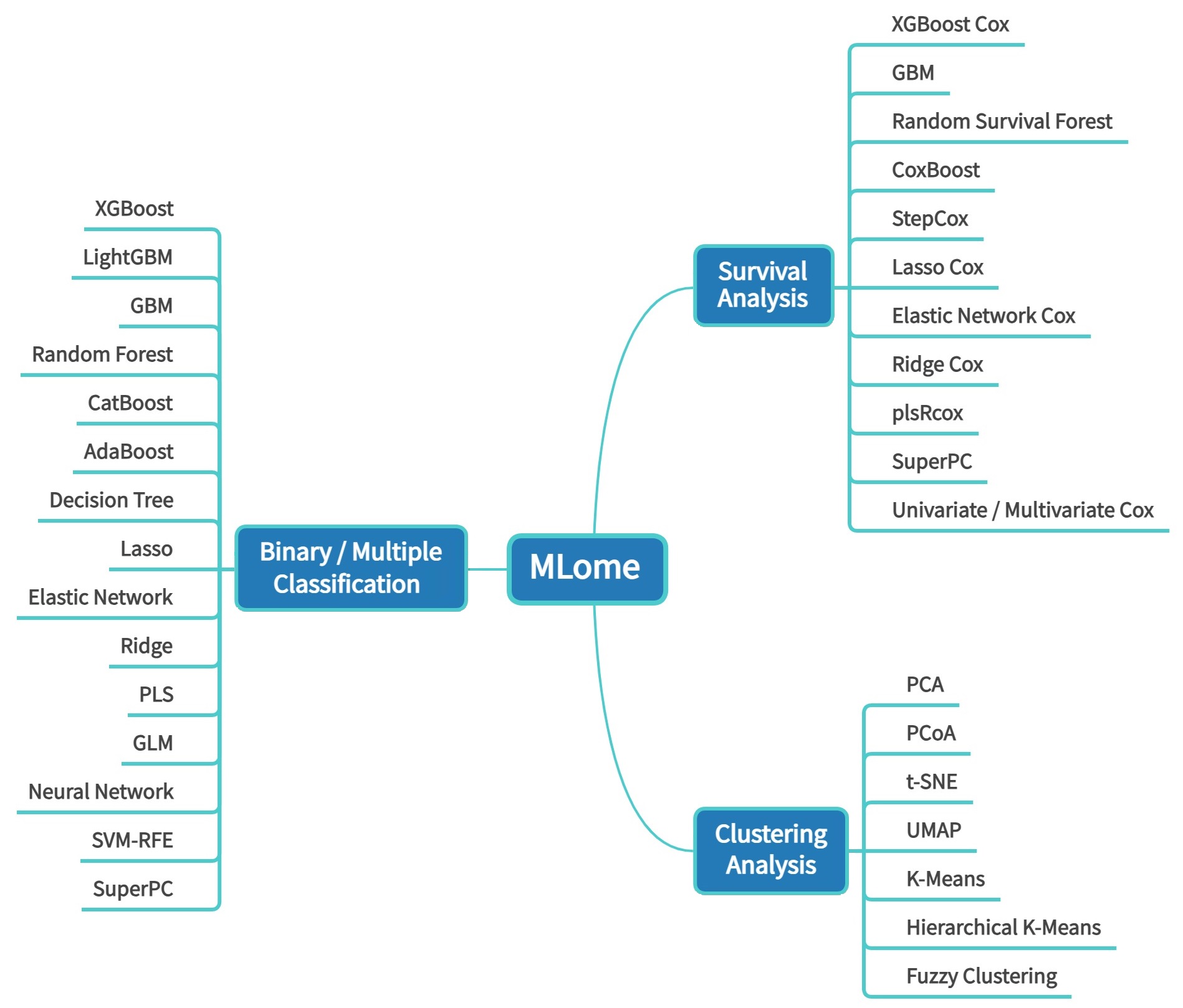
In recent years, machine learning technology, as the core driving force of artificial intelligence, has emerged in various fields with its unique advantages, and has attracted wide attention and research. Compared with classical statistical methods, machine learning technology can better conduct in-depth analysis and mining of massive data, and show great prospects in analyzing the potential relationships of high-dimensional data. In the field of biology, machine learning has become a key tool for accelerating scientific discovery and has been widely applied in various aspects such as omics data analysis, disease diagnosis and prediction, and the construction of large clinical language models.
The superior capabilities of machine learning stem from its diverse algorithmic principles, which handle complex patterns and nonlinear relationships in data from different perspectives. For instance, tree models and their integrated algorithms provide high-precision and easy-to-interpret models by constructing a series of judgment rules. Various regression models provide a solid statistical foundation and are particularly adept at analyzing the relationships between variables and risk factors. Clustering algorithms can spontaneously discover intrinsic subgroup structures from unlabeled data, providing the possibility for phenotypic stratification, and so on.
We have developed MLome, a data analysis and visualization platform based on machine learning The platform integrates 15 algorithms for binary/multiple classification analysis, 11 algorithms for survival analysis, and 7 algorithms for clustering analysis, and provides diverse visualization solutions at each stage. For supervised learning of binary/multiple classification and survival analysis, it offers multiple modules such as model generation, feature browse, model evaluation, and model application, helping users screen out key features and obtain appropriate models.